Electrolux Design Lab Competition

Each year Electrolux challenges design students all over the world to create a concept that is relevant to the time and raises questions about what design will be like in the future. Established in 2003, Electrolux Design Lab is a global design competition that is focused around themes such as healthy eating, sustainable living and internet generation. This year’s theme calls for Creating Healthy Homes under three focus areas; Culinary Enjoyment, Fabric Care and Air Purifying.

Electrolux Design Lab 2014 |Kitchen Studio Naples

Electrolux awards four prizes: 1st place is 5,000 Euros and a 6-month paid internship at an Electrolux global design center. A 2nd prize of 3,000 Euros, 3rd prize of 2,000 Euros and People’s Choice prize for 1,000 Euros are also on offer.

The competition received over 1,700 submissions from over 60 countries is now entering the second stage of the competition with 70 submissions moving forward. At this stage, contestants are asked to deliver rendered CAD-files of their concepts with a logo, contextual images and design details.

Starting tomorrow through June 28, the public can vote online for their favorite concept. The three most popular submissions in the public voting will make it directly to the next round.

You may vote for one concept only once, but you can vote for different concepts so it is ok to support more than one contestant and idea.

Explore Concepts

Tree of Life

Tree of Life| KitchAnn StyleReplacing the refrigerator, oven, dishwasher, and even the cook, the Tree of Life (TOL) is the brainchild of Bulgarian designer Zahari Ganchev.

Based on the shapes of a Beobab tree and a Ganoderma lucidum mushroom, the biomorphic Tree of Life stores your food in its trunk and cooks meals on its mushroom caps. Individual ingredients are drawn from their refrigerated, organic polymer pouches when you order up a dish. Lasers (lasers!) cut and clean the food before the appliance deposits them on ceramic-coated stainless steel plates and cooks them for you. Your nutritional intake is monitored every meal, and replacing your plate tells the cooking lasers (more lasers!) to clean it for you.

Halo Fuse

Halo fuse| KitchAnn StyleThe Halo Fuse is a rotating induction cooktop with the freedom of cooking anywhere on the surface and is designed to be located on an island work surface.  This concept was submitted by Ryan Gardner, a senior industrial design student at Kendall College of Art and Design.

Special pans with detachable handles are used with this concept so large meals with multiple pans can be easily accommodated. Temperature settings are selected through sliding electronic controls within the pot handle. The pans synch with the cooking surface so if you need to reposition it the same settings are kept.

Fortunately, there is also a touch screen interface located to the side of the cooktop to show the location and setting of each pan. This could be very handy for multiple chefs.

PureTowel

PureTowel |KitchAnn StyleIntended for bathroom use, the PureTowel replaces your standard towel hook with a Smart Hanger that can disinfect your towel in seconds with UV light. This clever concept comes from Leobardo Armenta, a 3rd year Industrial design student at Universidad Autonoma de Ciudad Juarez in Mexico.

Simply hang your used towel on the Smart Hanger and the vertical motion of the UV ring will start, leaving your towel dry and clean.

The towel is dried by a silent, high-speed fan located inside the ring and the UV light has sensors so human contact is avoided.

This concept is great for families concerned about allergies and passing germs that thrive on damp towels.

To explore the 35 entries and vote for our favorite, visit the Electrolux Design Lab site. Tell me which ones are your favorite.


Happy Father's Day

happy fathers day | Kitchen Studio of Naples

I wanted to pop in  for a sec – to give a shout out to all the dads on deck! Thanks, Dad for all that you’ve done over the years (especially the math homework) and helping to mold me into the person I am today.

What is a Cerused Finish?

Dark limed Kitchen | KitchAnn Style

Dating back to the 16th century, ceruse was a white lead derivative used as a cosmetic by luminaries such as Queen Elizabeth I. Highly toxic on human skin, it found favor with woodworkers, who used the lead-white and wax to fill the porous open grain of oak planks to deter insects and rot. After a while it became a fashionable way to lighten up and enhance the look of wood.

Also known as “limed oak,” the finish was popular throughout the Art Deco era and employed by notable midcentury modern pioneers including Parisian Jean-Michel Franck and Viennese-born Paul T. Frankl. A version of the technique, with a whitened grain contrasting against a black stain, was widely imitated in the 1950s.

Frankl for Saltman Furniture Co | KitchAnn Style

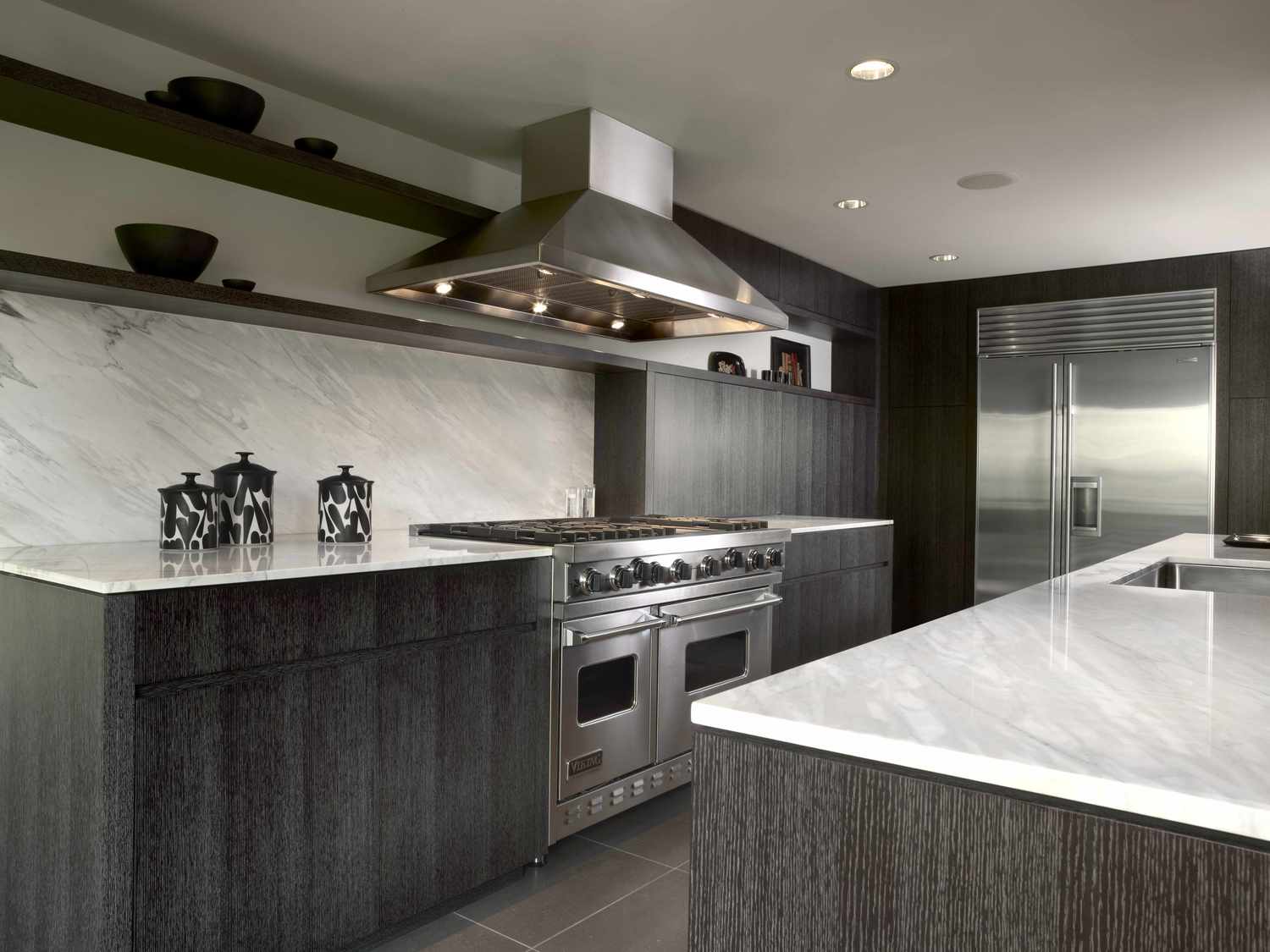
A cerused finish on cabinetry is created by using a wire brush across the surface to expose the natural grain of the wood. The base color and a glaze coat are applied to accentuate the unique patterns within the grain. Cerused cabinets have a weathered appearance.

Dark limed Kitchen | KitchAnn Style

This finish is most popular on Oak and Ash because of their open grain structure but I have seen it done on Alder and Walnut.

Today, cabinet makers are raising the grain on extra thick slab veneered doors. Paired with streamline hardware , a more modern look is obtained. This look is also popular with industrial accents to invoke an urban chic interior.

Rough Chic | Kitchen Studio of Naples

Colored pigments are also popular and as the demand for “driftwood” finishes starts to wain, expect to see more colors options available.

A word of caution, overuse of this finish can be distracting and knowing how to make it flow with the rest of your home’s decor is very important. Also be aware that I had seen slab doors where half the door takes the color one way and as the grain changes, the other half soaks it up another way. When working with a lighter cerused finish, always order a sample door, don’t work from a small color chip.

Transitional Kitchen | KitchAnn Style

From inspiration and to see samples come see me in the showroom. 3415 Radio Rd., Suite 102, Naples, FL 34104

Brown Ash Scattered Showers | Kitchen Studio of Naples   Knotty Brown Ash Red Alert | Kitchen Studio of Naples


Shape The Future of Black

Do you have what it takes to Shape the Future of design? DuPont Corian has established an international design competition that has been launched across the Europe, Middle East and Africa region.

Participants are invited to conceive an interior design solution (such as furnishing, tables, seating, vanities, vertical cladding, etc…) for one of the following with the new DeepColour blacks:

• home environment (kitchen, bathroom, living room, bedroom, etc…)

• public/commercial spaces (hotels, hospitals and medical facilities, shops, restaurants, bars, yachts, offices, airport  and train stations, museums, banks, shopping centers, theaters etc…)

The contest excludes flooring and ceiling applications, lighting equipment, accessories and small objects. Entry deadline is June 15th, 2014.

Corian DeepColour | KitchAnn Style
The result is to give architects, designers and fabricators the confidence to experiment with the material through all manner of volumetric or surface treatments. “The newness of this technology and the depth of these colors offers designers something to play with that they haven’t had before,” says Mark Woodman, lead design consultant for Corian.

Consider the work of the Giles Miller Studio. I saw their amazing tiles at the London Design Festival last fall.

When the LDF needed  a feature desk for the V&A entrance , the organizers approached Giles Miller for a solution that was the opposite of “off-the-shelf.” In response, Miller developed a system of intricately patterned, machine-cut panels that could be arranged volumetrically. The triangular panels, each uniquely grooved with a different surface treatment, were laid out in opposite directions, creating a dazzling effect of light and shadow.

Giles Miller Desk for VA | KitchAnn Style

Miller, who typically works with metals and other reflective materials was new to Corian, yet he was able to achieve the same, polished metal effect using only DeepColor solid surface. “Before we made the final desk, we laid the tiles out on the floor of our studio and saw the effect of the reflection,” recalls Miller. “We were blown away by the ability to make intricate profiles and have them all reflect light.”

For those who dare to use Corian as more than just sheet goods, you may have encountered “stretch marks” as you manipulated and formed the surface. DeepColor, however, now eliminates those unsightly lines and other imperfections, such as scratches, a constant issue with darker surfaces.

The new collection of solid surfaces is currently available in four dark, lustrous hues—Anthracite, Nocturne, Night Sky and Black Quartz. Still under wraps in DuPont’s labs, an extended palette of colors is about to be added to Corian family of colors.

Milan Design Week Corian | KitchAnn Style