Good Design

How will the ongoing recession affect our interest in good design?

This is a question many designers are thinking about right now.  Without a doubt we are spending more time in our homes.  Our home is where we feel safe in an uncertain world.  Staying home and entertaining at home also saves us money.

Trend analyst Faith Popcorn pointed out how people were living in a recessionary climate before the economists would admit that the recession existed.

“The overwhelming reaction is to pair down, to simplify…Nearly everyone is considering opting for a simpler life as we believe there is a real relief in getting off the consumer treadmill.”

Our time is very precious these days and we want our homes to be convenient and help us relax.  Good design is critical in helping a person feel connected to their home and insulated from the problems outside their door.

A recession can have a positive side in that it makes us (whether we’re willing or not) re-assess, and chose to do things more intelligently next time.  The interest in renewable resources, repurposing and eco-friendly products is at an all-time high level.  While it seems only 30% of people are willing to spend more for Green products, the interest keeps pressure of companies to reevaluate their raw materials, manufacturing and packaging.

Instead of “Keeping up with the Joneses”, people are now in a competition to keep down with the Joneses.  This battle to see who can do with the least has created a cultural mindset that less is more.  As Faith puts it, “it’s cooler not to spend.”

As a designer I am forced to step up my game because people still want and need an emotional link with the spaces I design.  The trick is to find and incorporate the one item they are excited or sentimental about.  This can include designing an heirloom hutch into a new kitchen or resurfacing the ball and claw tub from the salvage shop for the master bathroom.

The one area where I find people are spending more is in organizational tools and storage aids.  One reason is due to families downsizing their homes.  With individuals moving into smaller homes, more creativity and organizational skills are needed to store their belongings.  Another reason is due to the popularity of minimalist design and the desire to have things put away instead of out in the open.

As a person who admittedly tends to hold on to things too long and live amongst (some) clutter, I embrace this chance to rediscover what it is I really need.


Petra Kitchen

Gianluca Tondi, owner of TM Italia Cucine, designed the Petra Kitchen presented at the Abitare il Tempo trade fair. Petra is a new type of custom kitchen that conceals the working components when not in use. A remote control opens the travertine top to reveal the cooktop and downdraft ventilation. The faucet and oven are also mechanized to raise and lower.

TM Italia Cucine calls their home automation system (domotics) “TM_touch’n’go”.  With the touch of a button you can open the kitchen and view the monitor, “TM_Vison,” for watching television or use the Internet connection for searching the web. 

The monitor is show raised on the left end in the first two photos. The tall cabinets are also sleek and have no decorative hardware housing dishes and the refrigerator.
I would love to have seen this in person.


Add to FacebookAdd to NewsvineAdd to DiggAdd to Del.icio.usAdd to StumbleuponAdd to RedditAdd to BlinklistAdd to Ma.gnoliaAdd to TechnoratiAdd to Furl

GE Develops Power Shifting Appliances

General Electric will be testing a line of appliances which can wirelessly communicate with special “smart” electric meters.

The electric meters, in use by many utility companies across America, send signals to the appliances that direct the appliances to alter operations to use less electricity during peak times.

”Now that ENERGY STAR® appliances are recognized by 75% of American consumers, the next step is to reshape when energy is being used,” said Kevin Nolan, Vice President Technology for GE Consumer & Industrial.

For example, the automatic defrost feature on GE refrigerators is initiated by the internal electronics based on the number of refrigerator door openings and other input signals. If the refrigerator can delay the defrost cycle from occurring during peak energy usage hours, consumers will save money by paying for the same amount of energy later in the day when the rates are lower.

The appliance does have the option to override the commands so the appliances can operate at full power during peak times.

GE will introduce the suite of Energy Management Enabled Appliances in the first quarter of 2009. The new “smart” appliances will include refrigerators, ranges, laundry pairs, microwave ovens, and dishwashers.

Add to FacebookAdd to NewsvineAdd to DiggAdd to Del.icio.usAdd to StumbleuponAdd to RedditAdd to BlinklistAdd to Ma.gnoliaAdd to TechnoratiAdd to Furl

Ofuro Bathtubs

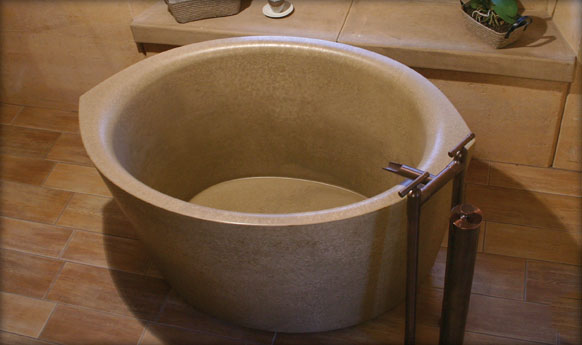
Ofuro Tubs | Kitchen Studio of Naples

The ofuro (お風呂), is a traditional Japanese bath with deep sides that allows the bather to immerse themselves up to the chin.

The ofuro has been used by the Japanese for centuries to alleviate both physical and spiritual maladies. This ancient technique of soaking in hot water takes away tensions and stress, soothes muscular pains, and stimulates the blood’s circulation.

The original style of ofuro is very small, barely fitting one person, scrunched up.  The water was heated by a wood stove and used by all members of the family and emptied in the evening.  It is part of the ritual of bathing and not for washing.  Members of the family are completely clean before immersing in the bath.  Although no soaps are used in the ofuro, mineral salts can be added to enhance the relaxation.

The ofuro were traditionally wooden boxes with 25″ deep straight sides. If you were like me and assumed the small size was due to the small bathroom size and the difficulties of keeping the water hot, you’d be wrong. The size originated from the notion that human beings experienced the best possible conditions in gestation.  The small size of the bath required the bather to sit in a fetal-like position.

Modern soaking tubs are larger and offer options like bubblers or jets.  This tub from Sonoma Cast Stone is made from Nucrete and offers the option for a heating coil to be cast into the tub’s body.

70 gallon 865 pounds

Ofuro are best designed into wet rooms since most do not have overflow drains.  Also, if you follow the bathing ritual, you would shower to clense your body, soak for a minimum of 15 minutes, get out and shower again, soak for an additional 15 minutes and finish with a cold shower.   Combining the shower and soaking tub will keep the tracking of water contained.

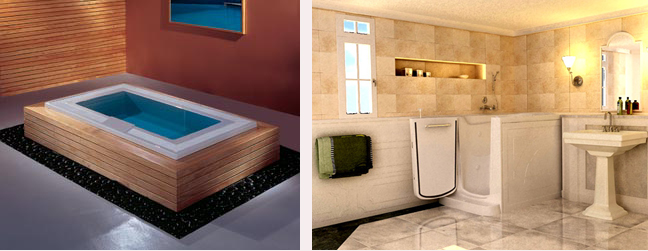
If the extra height of the ofuro has you concerned about your safety entering and exiting the tub, many models can be sunken or partially sunken into a deck. This unique soaking tub from the Zuma Collection features an infinity edge.  The tub is partially sunken so the deck is at a comfortable height.  Another option is a walk-in style tub.  You’ll need adequate floor clearance in front of it but it is a great option if you can’t change the floor.  It is also a great option for people who want to stay in their home well into their senior years.

Zuma Collection & Wasauna

Many people prefer to spend their time for relaxation and contemplation surrounded by nature.  Unfortunately, many traditional wooden ofuro are not suitable for outdoors.  Concrete ofuro, like this one from Concreteworks, are a popular choice because they hold up well to the elements.

Add to FacebookAdd to NewsvineAdd to DiggAdd to Del.icio.usAdd to StumbleuponAdd to RedditAdd to BlinklistAdd to Ma.gnoliaAdd to TechnoratiAdd to Furl