Kinetic Lighting Control and All White Bulbs for Philips Hue

Phillips Hue Tap | KitchAnn Style

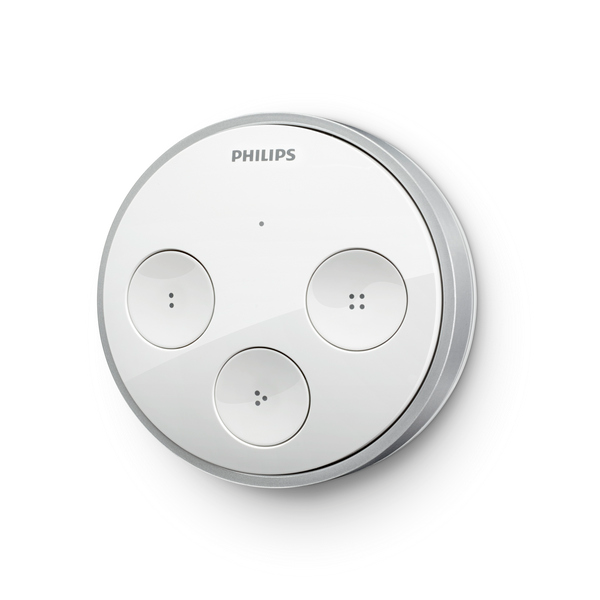
Philips’ hue lighting system is gaining two new components, a hue lux remote-control white bulb, and the hue tap, a clever little switch which makes controlling your favorite Hue light scenes even easier. And, since it’s kinetic-powered no batteries are needed.

Phillips Hue Tap | KitchAnn StyleThe new hue tap is built on Philips’ hue wireless lighting system, which has grown from the original iOS app-enabled, color-changing LED bulbs to an ecosystem of smart lighting accessories.

The tap is the first official product from Philips to bring hue lighting control out of the app and into the physical world.

Philips Hue tap needs no batteries as it operates using kinetic energy – simply through taps from your finger. As a result, it has a remarkable zero watts of power consumption and needs no main power source. Meaning it’s not only smarter, but greener and hassle free.

“Hue tap is the perfect solution for users who want to control their personal wireless lighting with yet more convenience. It is more than just a modern take on the wall switch – it combines easy-to-use traditional lighting control with the smart, intuitive, fun world of Philips Hue.” -Filip Jan Depauw, Senior Director, Philips Lighting

Philips Hue tap control requires the hue bridge found with all starter kits for Philips hue and Friends of hue products. Hue tap will be available this fall for $60.

Interestingly, Philips will open the hue tap API to third-party smart home developers. That potentially means easy installation of a multi-function switch that could be mapped to multiple different home automation products, addressing a common request in the growing smart home market.

Philips hue lux | KitchAnn Style

Philips has also introduced a new bulb called the hue lux, and it’s dimmable like the other hue bulbs (and other smart bulbs) but doesn’t do the chameleon color changing of the original bulbs. The lux bulb has a max lighting output of 600 lumens and temperature range from 2000-6500 Kelvin. Philips estimates hue will last 15,000 hours while drawing up to 8.5 watts at full intensity.

Hue lux works on the same ZigBee protocol, meaning users can incorporate the lights with third-party sensors, that the original color-changing hue bulbs use, but changes through white light intensity instead.

Philips says lux will go on sale this fall at a price of $39.99 each or $99 for a two-bulb starter kit that includes the hue wireless bridge.
Green Light

Bocci 38 | Kitchen Studio of Naples

If you’ve ever been told you needed live plants in your home but just felt like you didn’t have the space, this may be the solution you need.

Babylon suspended light | Kitchen Studio of Naples

Designed by Toronto-based multidisciplinary design studio O/I (Object Interface Inc.), Babylon is a plantable light fixture inspired by the legends of the Hanging Gardens of Babylon, one of the seven wonders of the ancient world.

The suspended light is made of powder coated aluminum with a removable ABS plastic liner. You can choose between the single light or a three light cluster. Pricing starts around $500.00

3 Babylon suspended light | Kitchen Studio of Naples

If you prefer a more enclosed option – especially if hanging over your kitchen table – this next light from Greenworks may be what you need. Also called Babylon, this light designed by Alexis Tricoire is a suspended terrarium of sorts.

Babylon Greenworks | Kitchen Studio of Naples

The suspended light fixture is about 19.5″ wide with 5 openings for stems to grow through.  The bottom of the globe is covered with pumice that contains minerals and micro nutrients that feed the plants. Due to the high water holding capacity of the pumice, plants need watering and maintenance only every third week.

Green Light Babylon Greenworks | Kitchen Studio of Naples

I love this photo with the orchids. I will admit I’m not the best when it comes to keeping orchids but If I had this fixture, I’d try to improve my skills.

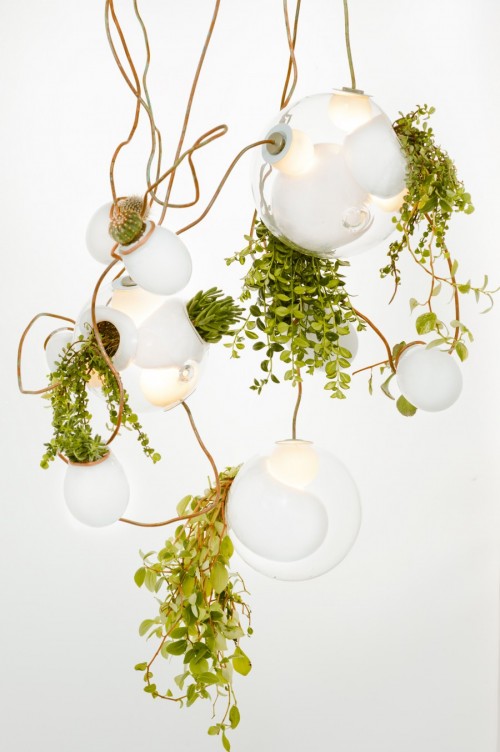
The last option I found for Green Lights is from the Bocci 38 Collection. This collection is an extension of the 28 series by Omer Arbel that features a series of distorted spheres filled with cavities that double as planters.

Green Light Bocci 38 succulent | Kitchen Studio of Naples

“This chandelier object, in production, uses a technique Mr. Arbel had previously used to create 28.  It takes an hour for three people to make one; 10% to 15% of them break in the process, says Mr. Arbel. This piece, 38, has cavities deep enough to contain earth and succulent and cacti plantings.”

Within the spheres there are 4-6 cavities, 2 or 3 of which house either a 10 watt xenon or a 1.5 watt LED light source. Electricity and suspension are achieved with stiff copper tubing, which is allowed to tangle and skew, seemingly without regard for gravity.

Green Light Bocci 38 | Kitchen Studio of Naples

Due to the hand crafted nature of the 38 series, the pendant size as well as the number and location of interior satellites, pendant diameter, and sometimes shape may vary.

Based in Vancouver with a satellite company in Berlin, Bocci is a contemporary design and manufacturing house that  follows sustainable practices. Bocci’s 38 Collection is made from recycled glass, lit by energy-efficient LED lights, and shipped in recyclable packaging.

Lumen Depreciation

As LED technology continues to evolve, so too grows the efficiency and lifespans of LED lamps. Because LEDs have such long lives (estimated at 35,000 to 100,000 hours), it’s rather challenging to measure precisely how long they really do last — few groups have the patience or resources to measure an LED in various environments for 5 or more years. However, the National Institute of Standards and Technology (NIST) is currently working on such a project.

Without a predictable failure point, manufacturers decided to define LED life as the amount of time it takes for the light to fade to a certain percentage of its original strength. “Lumen depreciation is widely understood in the lighting community and is not unique to LEDs. But it doesn’t come into play when you have a light source that only lasts hundreds or thousands of hours, as with incandescents. On average, incandescents fail before the eye notices a difference in their output,” says Philips Marketing Communications Director Steve Landau.

People in an average office setting can’t tell there is a change in illumination until a lamp has dropped 30% in output. So it is not objectionable to wait until the LED is at 70% of its original spec before you replace the lamp.

This designation is represented by the letter ‘L’ followed by a set of numbers such as:

L70 = time to 70% of original light output. There are other ratings, but this is the most common rating and is universally accepted as the standard to measuring LED life.

For colored accent and exterior lighting, the lumen acceptable lumen drop-off threshold is often considered to be 50%.

Still, even these numbers are highly variable depending on how and where the LED was operated. Things that may influence the LED’s life are line current, ambient temperature, the type of luminaire and the quality of the material used. These differences make defining a LED’s service life even more challenging, since the lamp’s environment can drastically influence its lifespan.

Simply, we can’t determine the service life of an LED without considering its housing and application. This is the major reason why the NIST is conducting their LED study. They are monitoring LEDs in various scenarios with the goal of uncovering a reliable method of projecting how long LEDs will last.

HOW LONG is 100,000 HOURS?

bulbsWhether you believe 100,000 hours is realistic or not, I’ve included a chart to make understanding the life of a 100,000 hour rated bulb easier.

Hours of Operation:  100,000 hours is:
24 hours a day                11.4 years
18 hours per day             14.8 years
12 hours per day             22.8 years
8 hours per day               34.2 years


Although the lighting industry is still learning about the efficiency of LEDs, what we currently know holds real promise for major energy savings in the future. And while the LED bulb you pick off the store shelf may not entirely live up to its 100,000 hour rating, it will certainly outperform most traditional bulbs.

LEDs and Carpet

LED integration into surfaces is growing by leaps and bounds and stands to add an exciting dimension to interior design. Let’s look at what is making news.

The Cell+LED Carpet from Lama Concept

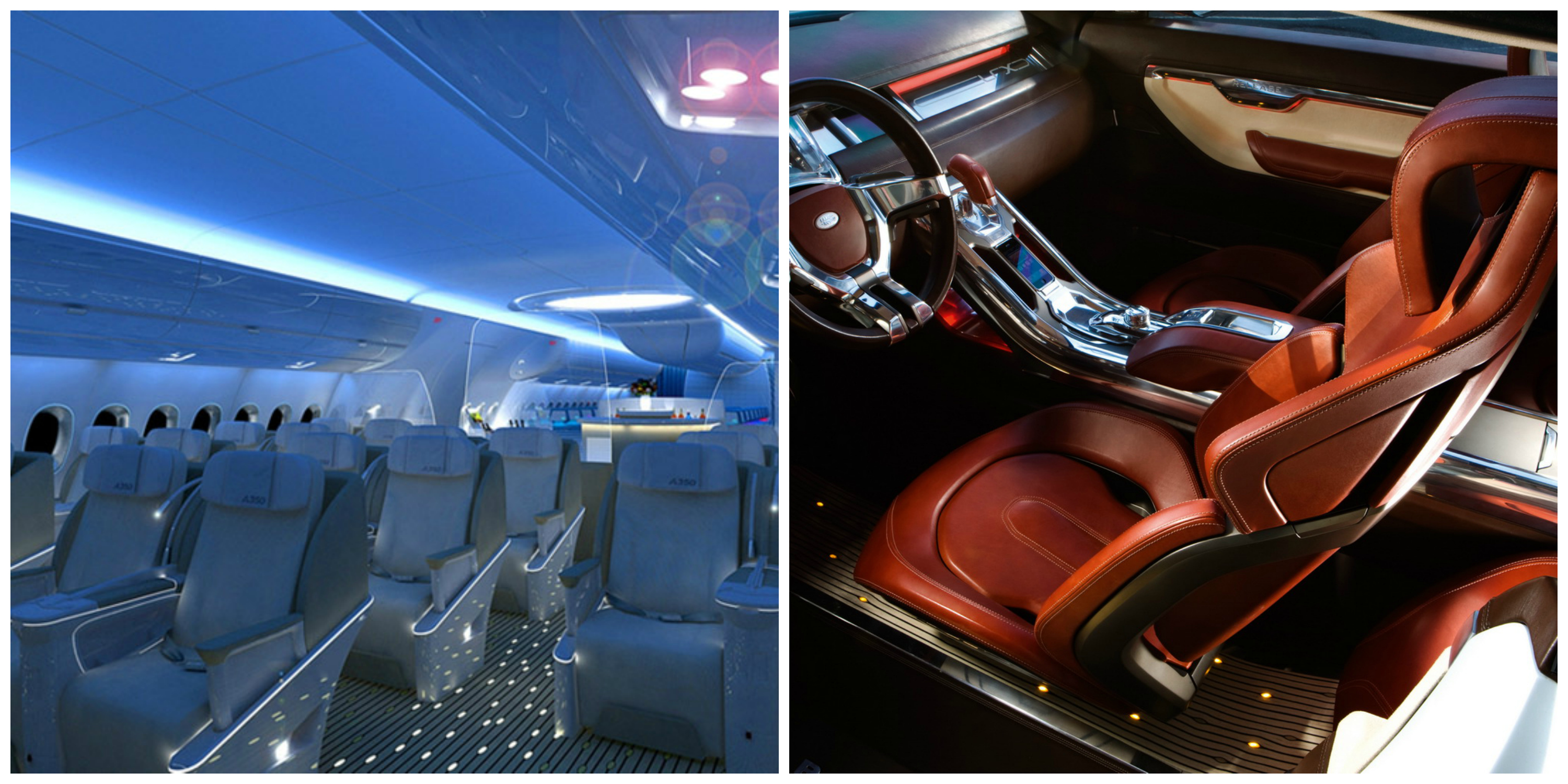
It’s hard to believe it’s been 7 years since this carpet made it’s debut at the Paris Airshow fitted into the isles of the Airbus A350. Since then it’s been used in various commercial applications and even in the Land Rover LRX Concept.

Lama Concept Cell | KitchAnn Style

The carpets and rugs are made from 100% wool felt strips that are formed around eye-like forms – like knots in wood. Some of these knots are replaced with LED lights and oriented with the direction of the strips. The carpets can be created to form a directional path with the LEDs, or the lights can just be placed randomly for a glittering array.

Lama Concept Cell | KitchAnn Style

Although this carpet might not work with every decor, it’s an innovate approach to flooring that opens the door to endless design possibilities.

Phillips and Desso

Two Dutch-based companies, Phillips Lighting and carpet maker Desso, recently announced a partnership to create light-transmitting carpet–smart flooring capable of displaying all kinds of information.

Desso LED  | KitchAnn Style

Desso envisions the new light emitting LED carpet as serving several purposes. One would be to quickly and intuitively guide people through buildings including to designated safety routes and exits. Another would be to add to the ambiance and atmosphere of public spaces. The carpet would add “lighting, design and color” as the joint statement from both companies explains.

For now, the partnership is limited to the EMEA (Europe, Middle East, and Africa) and the official product is slated for sometime in 2014.  Who knows, one day we may be able to turn an average living room into a disco lounge with the touch of our phones or tablets and use the same system with our fire alarms enabling it to send a signal to specifically light the best way out of our homes.